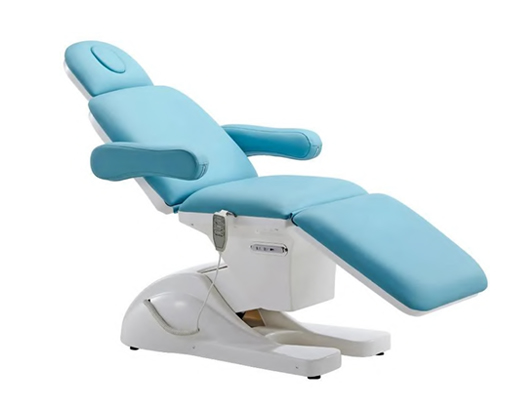
Professional treatment environments require furniture that supports much more than appearance. The seating must remain stable during repeated adjustments, provide comfortable positioning for clients, allow practitioners to work with controlled access, and withstand the cleaning routines expected in professional settings.
A well-designed treatment chair brings these requirements together through a combination of structural engineering, powered movement, ergonomic support, durable upholstery, and practical operating controls. It becomes part of the treatment workflow rather than simply occupying space in the room.
For clinics, dermatology centres, aesthetic facilities, skin-care studios, wellness centres, and professional salon environments, the right seating solution can improve positioning, practitioner access, client confidence, and day-to-day operational efficiency.
Treatment procedures often require changes in posture and working height. A fixed seat can limit access for the practitioner and make repositioning unnecessarily dependent on manual handling.
A professionally engineered treatment chair addresses this through controlled powered movement. Operators can adjust the working position according to the procedure being performed, while the client can remain supported throughout the transition.
The ability to move smoothly between positions is particularly useful when practitioners need improved access to different areas of the face, upper body, or other treatment zones. Controlled movement also helps avoid abrupt repositioning that can affect client comfort.
The design is therefore centred on workflow efficiency: position the client, establish the correct working angle, perform the procedure, and adjust the chair when the next stage requires a different posture.
The furniture is developed around practical features that matter during repeated daily use.
Electric actuation allows the operator to change the seating position without relying on manual lifting or mechanical repositioning. Smooth movement helps create a more controlled experience for both the practitioner and the client.
Height adjustment allows the practitioner to establish a more suitable working level. This can reduce unnecessary bending and awkward reaching during procedures that require concentration and precision.
Different procedures demand different body positions. A flexible configuration allows the chair to support seated, inclined, and more reclined working arrangements as required.
Certain treatments benefit from quick movement into a more reclined or inclined orientation. Controlled positioning allows staff to prepare the chair efficiently when the procedure demands it.
Adjustable arm support can improve client comfort while giving practitioners greater freedom around the treatment area. It also reduces the need for staff to repeatedly reposition the client's arms manually.
Simple controls are important in treatment environments. The operating interface should allow staff to make adjustments without interrupting their attention from the client or procedure.
The value of professional treatment furniture is measured through everyday usability, not appearance alone.
A properly engineered unit can contribute to:
For businesses managing multiple treatment rooms, these benefits become particularly important because furniture is exposed to frequent operation and repeated cleaning cycles.
Treatment furniture experiences a demanding operating environment. Movement mechanisms may be activated repeatedly throughout the working day, while upholstery can be exposed to body oils, creams, lotions, disinfectants, moisture, and regular wiping.
This makes fabrication quality important.
A dependable construction approach begins with a stable structural frame capable of supporting the intended loading conditions without unnecessary movement or instability. Moving components must be aligned correctly so that powered adjustments remain smooth and predictable.
The upholstery also requires careful attention. Cushion density, foam shaping, seam placement, and surface finishing all influence long-term comfort. Poorly selected cushioning can lose its resilience with repeated use, while weak stitching or unsuitable surface materials can become maintenance problems.
For professional environments, the objective is not simply to create a soft seat. It is to create a surface that combines comfort, support, cleanability, and durability.
The adaptable design makes this type of treatment seating suitable for several commercial settings.
Practitioners often need controlled access and different client positions during consultations and procedures. Adjustable positioning helps create a more suitable working environment.
Aesthetic procedures frequently require the client to remain comfortable while the practitioner works from different angles. Powered adjustment can simplify this process.
Facilities offering specialised facial and skin-care services can use adjustable treatment seating to create a more organised and premium client experience.
Where treatment services form part of a broader salon offering, versatile furniture can help maximise room functionality without compromising professional presentation.
Professional training facilities can also benefit from adjustable seating because instructors and learners may need to observe procedures from different working positions.
Client comfort is only one part of treatment furniture design. Practitioner ergonomics deserves equal attention.
Repeatedly working at an unsuitable height can encourage excessive bending, shoulder elevation, or awkward reaching. Over a full working day, these positions can contribute to physical fatigue.
Adjustable furniture allows the working position to be adapted to the procedure and the practitioner. This does not replace good ergonomic practice, but it provides a better foundation for maintaining a comfortable working posture.
The same principle applies to client positioning. Appropriate support can help the client remain relaxed and still, which is especially useful when procedures require precision.
Furniture used in professional treatment environments should be selected with routine maintenance in mind.
Smooth, accessible surfaces are easier to wipe and inspect. Upholstery should be compatible with the cleaning products and procedures used by the facility. Operators should also periodically inspect moving components, electrical connections, fasteners, upholstery seams, and support points.
Good maintenance practices include:
These practices help preserve both operational reliability and professional presentation.
Furniture purchasing decisions should consider the entire operating lifecycle rather than only the initial purchase price.
A well-built treatment chair can contribute to smoother workflows, improved room functionality, better client experience, and reduced dependence on manual repositioning. For expanding facilities, selecting dependable equipment from the beginning can also create greater consistency across multiple rooms.
This becomes especially valuable for clinics and professional facilities that need furniture capable of supporting daily commercial workloads rather than occasional personal use.
Dalmore approaches professional furniture from a practical manufacturing perspective, combining functional design with fabrication quality and application-focused engineering. The product range covers treatment, salon, spa, massage, facial, pedicure, and related professional environments, allowing businesses to consider furniture as part of a coordinated workspace rather than as isolated purchases.
The company also focuses on custom-made furniture solutions, giving commercial buyers greater flexibility when planning interiors around specific operational requirements.
For businesses in Gurugram, Delhi NCR, and other Indian markets, working with an established manufacturer can simplify product selection, customisation discussions, project coordination, and after-sales communication.
The emphasis should ultimately remain on dependable construction, practical functionality, comfortable positioning, and suitability for repeated professional use.
Professional treatment furniture should make the working environment easier, not more complicated. Controlled movement, ergonomic positioning, dependable construction, comfortable support, and practical maintenance all contribute to that objective.
When these elements are considered together, the result is furniture that supports practitioners while creating a more comfortable and professional experience for clients.
For clinics, aesthetic centres, wellness facilities, salons, and other professional treatment environments looking for dependable furniture solutions, Dalmore can help develop and supply equipment aligned with the practical demands of modern treatment spaces. Contact the team to discuss your application, workspace requirements, and suitable furniture solution.

