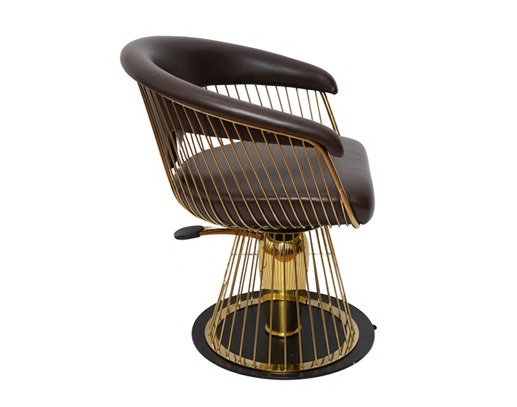
Professional grooming environments demand furniture that can handle continuous use while maintaining comfort, stability, and visual consistency. The Vogue Styling Chair is designed around that practical requirement, combining a structured seating platform with a refined appearance suitable for contemporary salon interiors.
Its value is not limited to the way it looks. A professional chair must support the working position of the stylist, provide dependable seating for different clients, remain stable during service, and withstand the repetitive demands of a commercial environment. These considerations influence the selection of the frame, cushioning, upholstery, fittings, and overall construction.
For salon owners, interior designers, procurement teams, and project contractors, the right furniture is an operational investment. It affects client comfort, stylist movement, workspace efficiency, maintenance requirements, and the overall impression of the establishment.
A commercial seating unit experiences considerably more stress than residential furniture. It may be occupied repeatedly throughout the day, moved during cleaning, exposed to hair products and moisture, and subjected to frequent changes in user weight and posture.
The construction therefore needs to work as a complete system.
The structural frame provides the foundation for load distribution and stability. Cushioning needs to retain its form under repeated compression rather than becoming excessively soft or uneven. Upholstery must be selected with commercial use in mind, particularly where regular cleaning is required.
The design also considers the relationship between the chair and the stylist's working area. Excessively bulky furniture can restrict movement, while poorly proportioned seating can make routine services uncomfortable for both the customer and operator.
The visible finish is only one part of a well-built professional chair. Long-term performance depends heavily on what sits underneath the upholstery.
During fabrication, structural components must be properly aligned so that the finished unit does not develop unwanted movement or uneven loading. Welded or mechanically joined sections require appropriate preparation and inspection because small inconsistencies in the frame can become noticeable after repeated use.
Cushion construction is equally important. Foam density, thickness, compression characteristics, and shaping influence how the chair feels initially and how it performs after prolonged use. Cushioning that is too soft may lose support quickly, while excessively firm construction can reduce comfort during longer appointments.
Upholstery is then fitted over the prepared structure with controlled tension. Proper pattern alignment, seam placement, edge finishing, and attachment contribute to both appearance and durability.
This manufacturing approach matters to commercial buyers because furniture replacement is rarely convenient once a salon is operational. A product selected for professional use should therefore be evaluated for construction quality rather than appearance alone.
Comfort contributes directly to how customers perceive a professional service. Stable seating, supportive cushioning, and a well-finished surface create a more controlled environment during appointments that may require clients to remain seated for extended periods.
Furniture should work with the stylist rather than obstructing the working area. Appropriate proportions and stable positioning help create a predictable workstation, allowing professionals to move around the client efficiently.
Commercial grooming spaces require regular cleaning. Smooth, properly finished upholstery surfaces and accessible construction areas can make routine maintenance more manageable.
Furniture forms a significant part of the visual identity of a salon. A coordinated seating solution can help maintain a professional appearance across individual workstations and larger commercial projects.
For business owners, the cost of furniture should be considered alongside expected usage, maintenance, durability, and replacement frequency. A professionally manufactured unit can provide greater operational value when these factors are considered together.
The Vogue Styling Chair can be considered for a range of commercial interior applications where dependable seating and coordinated presentation are important.
Typical applications include:
For larger installations, procurement should consider more than the number of units required. Floor layout, service workflow, access paths, cleaning routines, installation sequence, and visual consistency can all influence the final furniture selection.
Buying furniture for a professional establishment is different from selecting a decorative seating product for occasional use. Commercial buyers need predictable quality, repeatability, communication, and dependable fulfilment.
For multiple-unit orders, consistency becomes especially important. Seat proportions, upholstery application, finishing, and structural alignment should remain uniform across the supplied units so that the completed interior looks professionally coordinated.
Project buyers may also need to evaluate delivery requirements, installation access, colour or upholstery selection, quantity planning, and compatibility with the broader furniture package.
A manufacturer-led approach makes it easier to discuss these requirements before production rather than attempting to modify the furniture after installation.
Two chairs can appear similar in a showroom photograph while performing very differently in daily commercial conditions.
The difference may come from frame preparation, joint quality, foam selection, upholstery tension, fastening methods, base stability, or finishing control. These details are not always visible from an image, but they influence the service life and user experience of the finished product.
That is why professional procurement should evaluate furniture through both design and construction.
For a salon planning a new interior, expanding to additional workstations, or replacing ageing furniture, this approach helps balance appearance with practical performance.
The Vogue Styling Chair is suited to businesses that want professional seating without separating design considerations from everyday operational requirements. Its construction-led approach makes it relevant for individual salon owners as well as designers, contractors, hospitality projects, and commercial procurement teams.
Before ordering, buyers can review their required quantity, preferred finish, available workstation space, installation conditions, and intended usage. These details help determine the most suitable configuration for the project.
If you are planning a new professional grooming space, upgrading existing workstations, or sourcing furniture for a larger commercial project, discuss your requirements with the Spalon Furniture team.
Share your project quantity, preferred configuration, interior requirements, and delivery expectations to receive guidance on the appropriate furniture solution and production specifications.

